Tuning T-Match Tuner
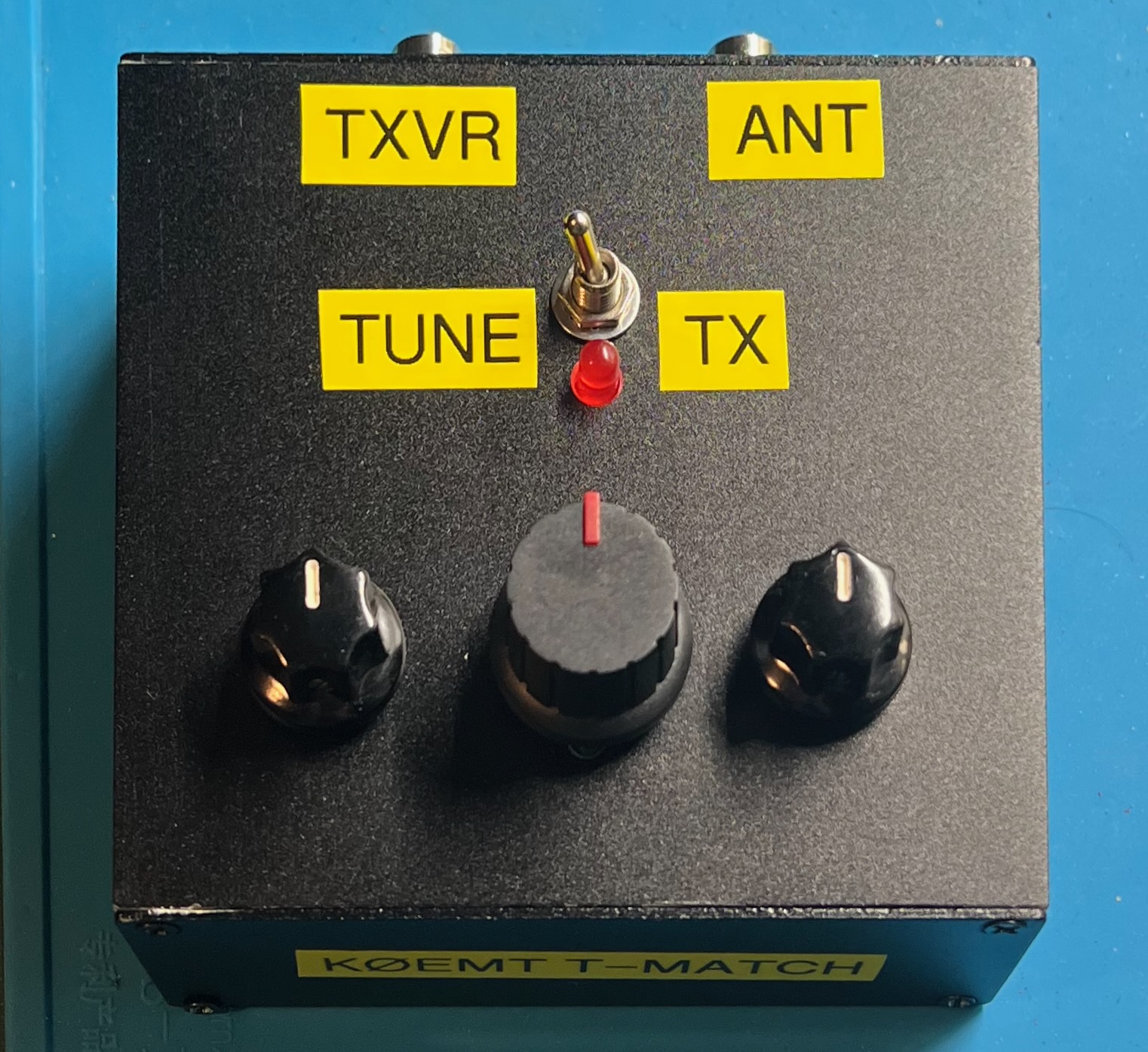
Read about the T-match
Using the T-Match
There are various ways of tuning the T-match. Some are more lossy than others.
Traditional mid-C procedure
The procedure:
- Tune to the desired frequency.
- Start with inductor at minimum, transceiver cap and antenna cap at MID position.
- Adjust inductor for maximum noise.
- Start with antenna side cap adjusting for maximum noise, then transceiver side.
- Flip the Tune/Transmit switch to Tune.
- Key the transceiver and adjust capacitors to the dimmest LED showing possible.
- DO NOT switch the inductor setting while transmitting.
- Stop transmitting. If you were not able to get a good match try reducing or increasing inductance and repeat the tuning procedure.
- Once you are satisfied, return the Tune/Transmit switch to Transmit.
max-C procedure
The procedure:
- Tune to the desired frequency.
- Start with inductor at minimum, transceiver cap and antenna cap at MAXIMUMUM position.
- Adjust inductor for maximum noise.
- Start with antenna side cap adjusting for maximum noise, then transceiver side. TODO: which side to adjust first?
- Flip the Tune/Transmit switch to Tune.
- Key the transceiver and adjust capacitors to the dimmest LED showing possible.
- DO NOT switch the inductor setting while transmitting.
- Stop transmitting. If you were not able to get a good match try reducing or increasing inductance and repeat the tuning procedure.
- Once you are satisfied, return the Tune/Transmit switch to Transmit.
min-C procedure
The procedure:
- Tune to the desired frequency.
- Start with inductor at minimum, transceiver cap and antenna cap at MINIMUM position.
- Adjust inductor for maximum noise.
- Start with antenna side cap adjusting for maximum noise, then transceiver side.
- Flip the Tune/Transmit switch to Tune.
- Key the transceiver and adjust capacitors to the dimmest LED showing possible.
- DO NOT switch the inductor setting while transmitting.
- Stop transmitting. If you were not able to get a good match try reducing or increasing inductance and repeat the tuning procedure.
- Once you are satisfied, return the Tune/Transmit switch to Transmit.
1/4-c procedure
With the min-C and max-C approaches I often found that when it came to fine tuning I was stuck since the other control was either at a minimum or maximum.
The procedure:
- Tune to the desired frequency.
- Start with inductor at minimum, transceiver cap and antenna cap at one quarter C position.
- This is halfway between min-C and mid-C starting points.
- Adjust inductor for maximum noise.
- Start with antenna side cap adjusting for maximum noise, then transceiver side.
- Flip the Tune/Transmit switch to Tune.
- Key the transceiver and adjust capacitors to the dimmest LED showing possible.
- DO NOT switch the inductor setting while transmitting.
- Stop transmitting. If you were not able to get a good match try reducing or increasing inductance and repeat the tuning procedure.
- Once you are satisfied, return the Tune/Transmit switch to Transmit.
Testing Procedure
- Set up a NanoVNA with s11 set to SWR and s21 set to log mag (insertion loss).
- Calibrate NanoVNA.
- NanoVNA CH0 connected to TXVR jack of T-Match.
- NanoVNA CH1 connected to ANT jack of T-Match.
Select a frequency, then tune for a match using the various procedures.
| Frequency | Procedure | SWR | Log Mag dB | Notes |
|---|---|---|---|---|
| 28.060 MHz | min-C | 1.115 | -3.42 | |
| 28.060 MHz | 1/4-C | 1.014 | -2.92 | |
| 28.060 MHz | mid-C | 1.034 | -2.82 | |
| 28.060 MHz | max-C | 1.28 | -13.16 | |
| 14.060 MHz | min-C | 1.361 | -1.05 | all inductor – no C added |
| 14.060 MHz | 1/4-C | 1.349 | -1.10 | mostly the same |
| 14.060 MHz | mid-C | 1.041 | -4.13 | |
| 14.060 MHz | max-C | 1.036 | -8.75 | |
| 7.1 MHz | min-C | 1.290 | -1.29 | all inductor – no C added |
| 7.1 MHz | 1/4-C | 1.108 | -1.99 | |
| 7.1 MHz | mid-C | 1.062 | -4.48 | |
| 7.1 MHz | max-C | 1.051 | -13.12 | C2 at max |
| 3.58 MHz | min-C | 1.142 | -3.79 | |
| 3.58 MHz | 1/4-C | 1.089 | -4.42 | |
| 3.58 MHz | mid-C | 1.48 | -5.35 | |
| 3.58 MHz | max-C | 1.393 | -14.9 |
Conclusions
- Least amount of loss was observed when using traditional mid-C or 1/4-C starting position for C.
- Further research with a real-world antenna needs to be done.
- Set up a test fixture and observe Power In and Power Out of T-Match.
- This would still not account for loss in a 9:1 transformer after the matching unit.
- All of the observed loss points to why a QRP station should utilize a resonant antenna to achieve maximum radiated RF energy.
Nice video from @TheSmokinApe on insertion loss. Illustrates using a nanoVNA for tuning.
Getting the Most Out of Your T-Network Antenna Tuner
QST January 1995, pp. 44-47
Here’s how to adjust this popular tuning circuit so it transfers maximum power to your antenna.